


BeikeShop v3.0 AI Upgrade: Agents, Plugins & MCP

BeikeShop Official Website: beikeshop.com
BeikeShop is a premier open-source e-commerce system built on the Laravel framework. Specifically designed for cross-border trade, it offers a fully customizable, multi-language, and multi-currency solution for businesses looking to scale their independent global storefronts.
When AI enters an e-commerce platform, the real question is not whether it can connect to a large language model. It is whether AI can participate in real business operations securely and reliably—and continue to grow as the business evolves.
BeikeShop v3.0 License Edition introduces comprehensive AI integration and extensibility, creating a complete path from AI assistants and business tools to admin interfaces and permission management. The admin panel already includes three business-focused Agents for order management, customer insights, and product management, covering high-frequency operational scenarios.
AI is no longer limited to a standalone chat page. It can become part of the store's capabilities: understanding business scenarios, invoking authorized tools, and gaining new skills through plugins. For example, the Order Management Assistant can help query orders, update statuses, and track progress. The Customer Insights and Product Management Assistants provide collaborative entry points for customer profiles, after-sales refunds, inventory checks, product creation, and product-title or selling-point optimization.
What Problems Does an Extensible AI Architecture Solve?
Every merchant has different priorities. Some focus on orders and performance data; others need to maintain content frequently; still others want to connect specific service workflows to the admin panel. If AI capabilities are hard-coded into the core system, customization becomes costly and future upgrades become more difficult.
BeikeShop's AI plugin mechanism provides a more sustainable approach. Developers package new capabilities inside plugins and connect them through standardized entry points instead of modifying core AI files directly.
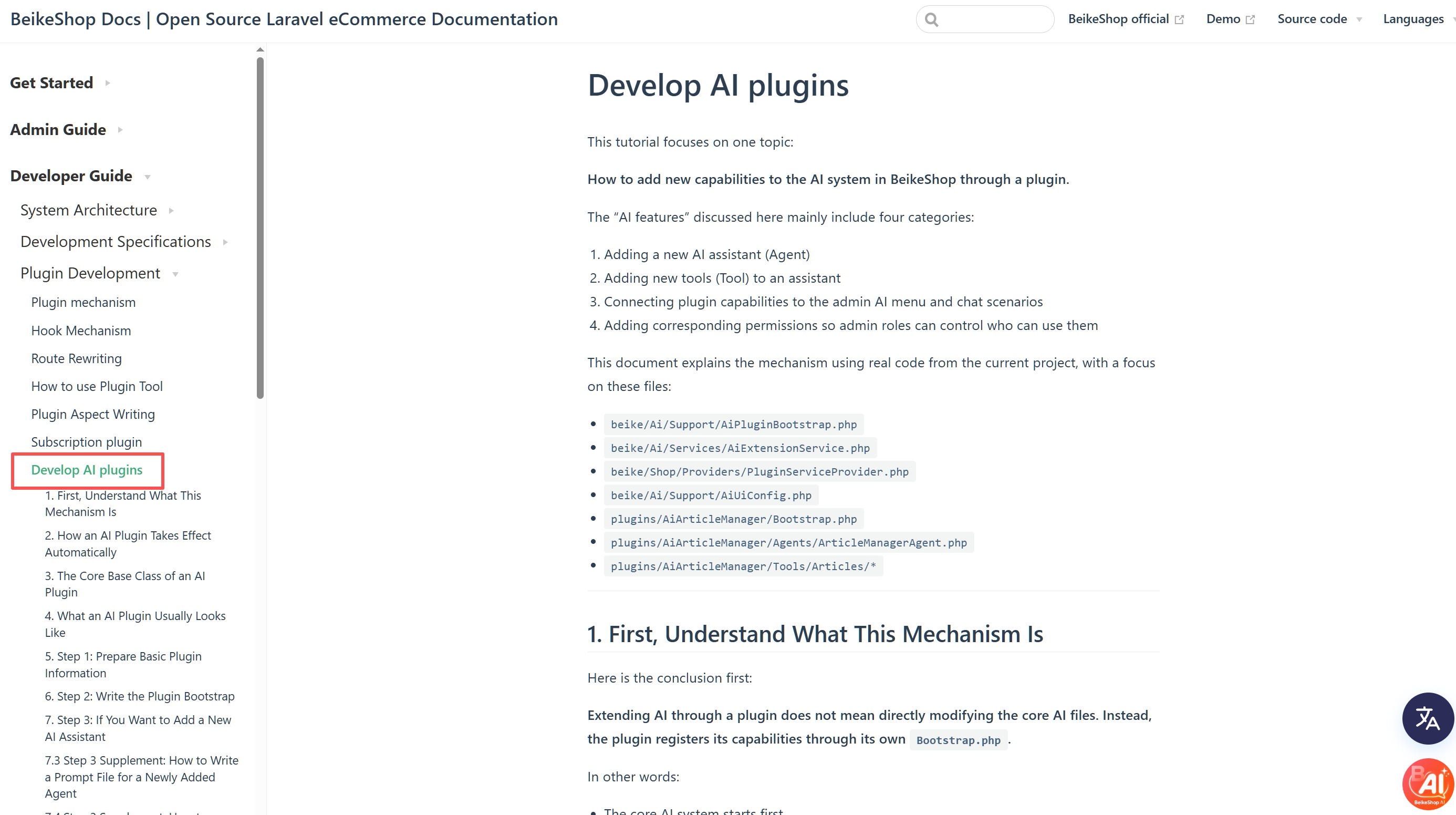
For guidance on developing AI plugins, see the documentation below: ⬇️
https://docs.beikeshop.com/dev/ai_plugin.html
Plugins can be installed, enabled, and disabled independently. This reduces intrusion into the main system while keeping the boundaries of each business capability clear and maintainable.
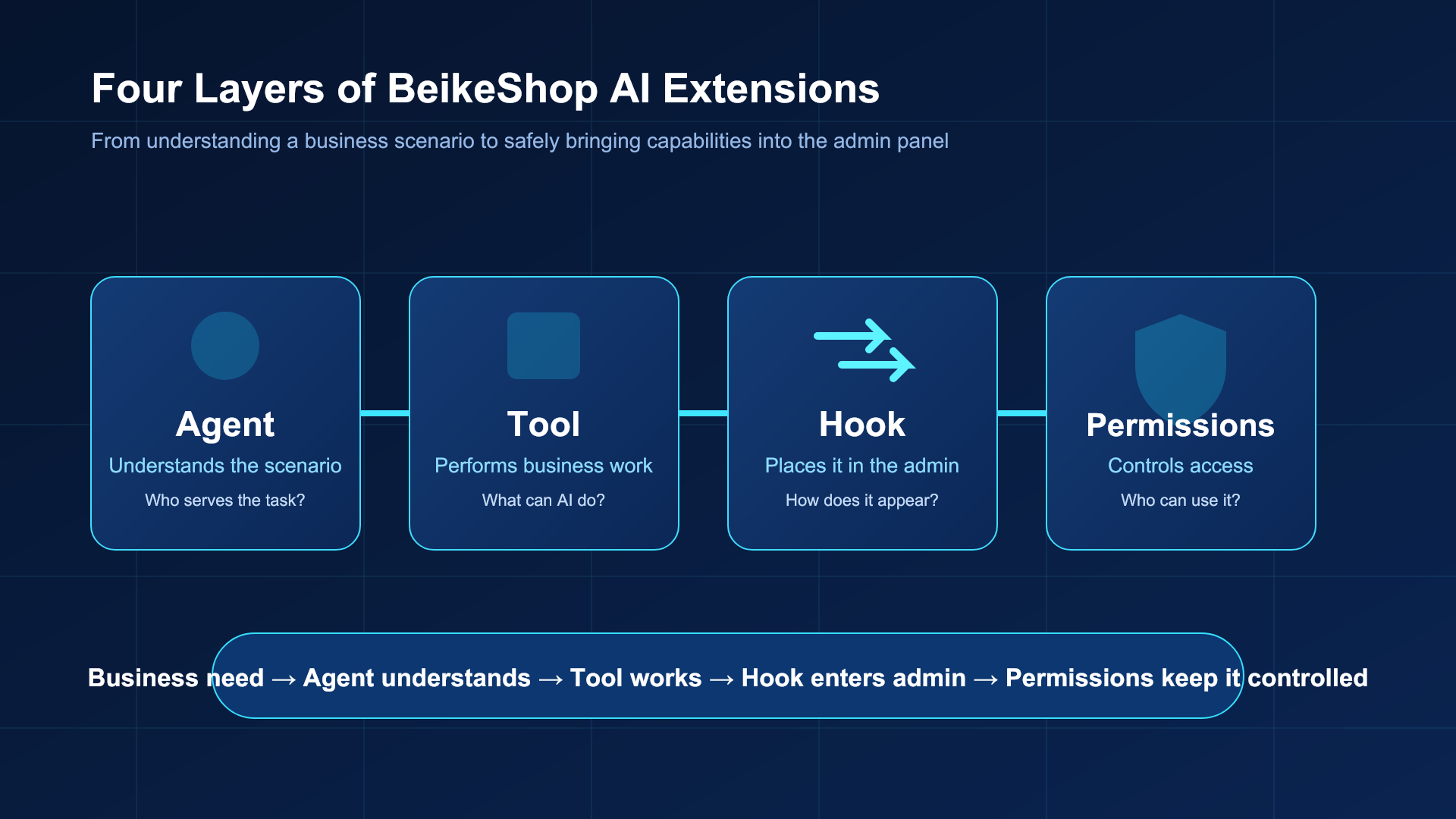
Four Key Roles: Agent, Tool, Hook, and Permissions
Understanding BeikeShop AI extensions does not require diving into complex code first. Think of the system as four components working together.
Agent: Decides who serves the scenario
An Agent is an AI assistant for a specific business scenario. A plugin can add a dedicated assistant and define its role, welcome message, and quick prompts. It can also extend the instructions of an existing assistant without replacing the core logic.
Tool: Decides what AI can do
A Tool is the business capability that AI actually invokes. It can retrieve information, process data, or perform authorized operations. Developers can register new tools and attach them to the right Agent, preventing unrelated business scenarios from becoming mixed together.
Hook: Decides how capabilities enter the admin panel
With Hooks, plugins can add entries to the AI menu, configure scenario titles and welcome messages, or supplement an existing Agent's instructions. New capabilities can therefore appear naturally in the user's workflow without directly changing core front-end pages.
Permissions: Decide who can use the capability
The closer an AI capability gets to business operations, the more important permission controls become. BeikeShop supports permissions for Agents and Tools within the admin role system. Different roles can receive access, read, edit, or other permissions as needed, keeping both efficiency and governance in place.
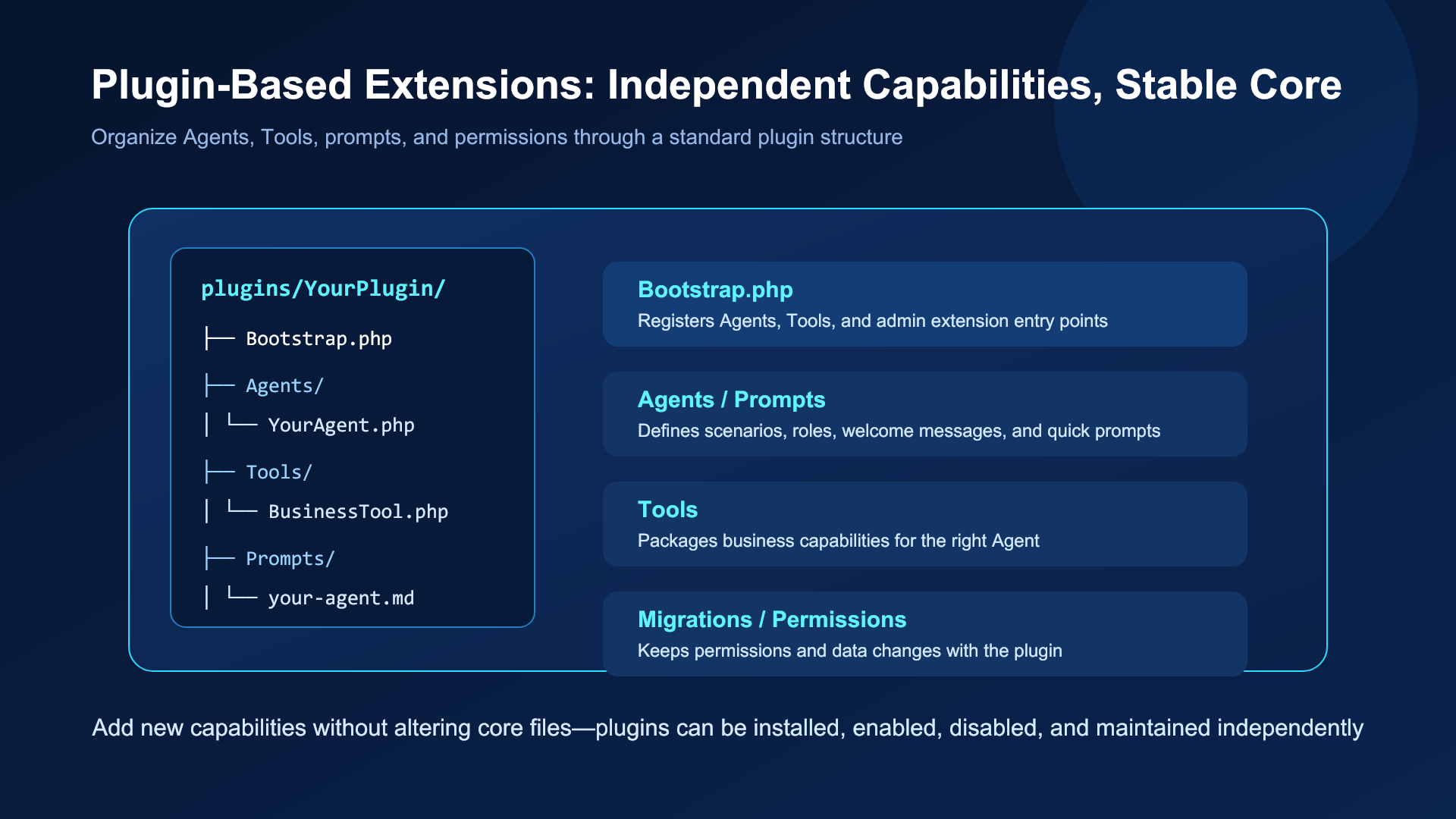
Plugin Development: Add Capabilities Without Altering the Core
In BeikeShop's AI plugin structure, Bootstrap is the entry point that connects a plugin to the AI system. It registers Agents, Tools, and later extensions, while prompts, tool logic, and permission migrations can remain organized and maintained within the plugin itself.
This design provides three direct benefits:
- More confident upgrades: Plugins do not need to modify core files, reducing maintenance pressure during version upgrades.
- Clearer capabilities: Each plugin can focus on a specific business scenario, making its scope and responsibility easier to understand.
- A more open ecosystem: Service providers and developers can build specialized capabilities around customer needs and deliver them as plugins.
The official development documentation provides a complete path from adding an Agent and registering a Tool to configuring admin scenarios, permissions, and tests. For teams looking to embed AI deeply into their stores, it is an infrastructure layer that can be adopted step by step.
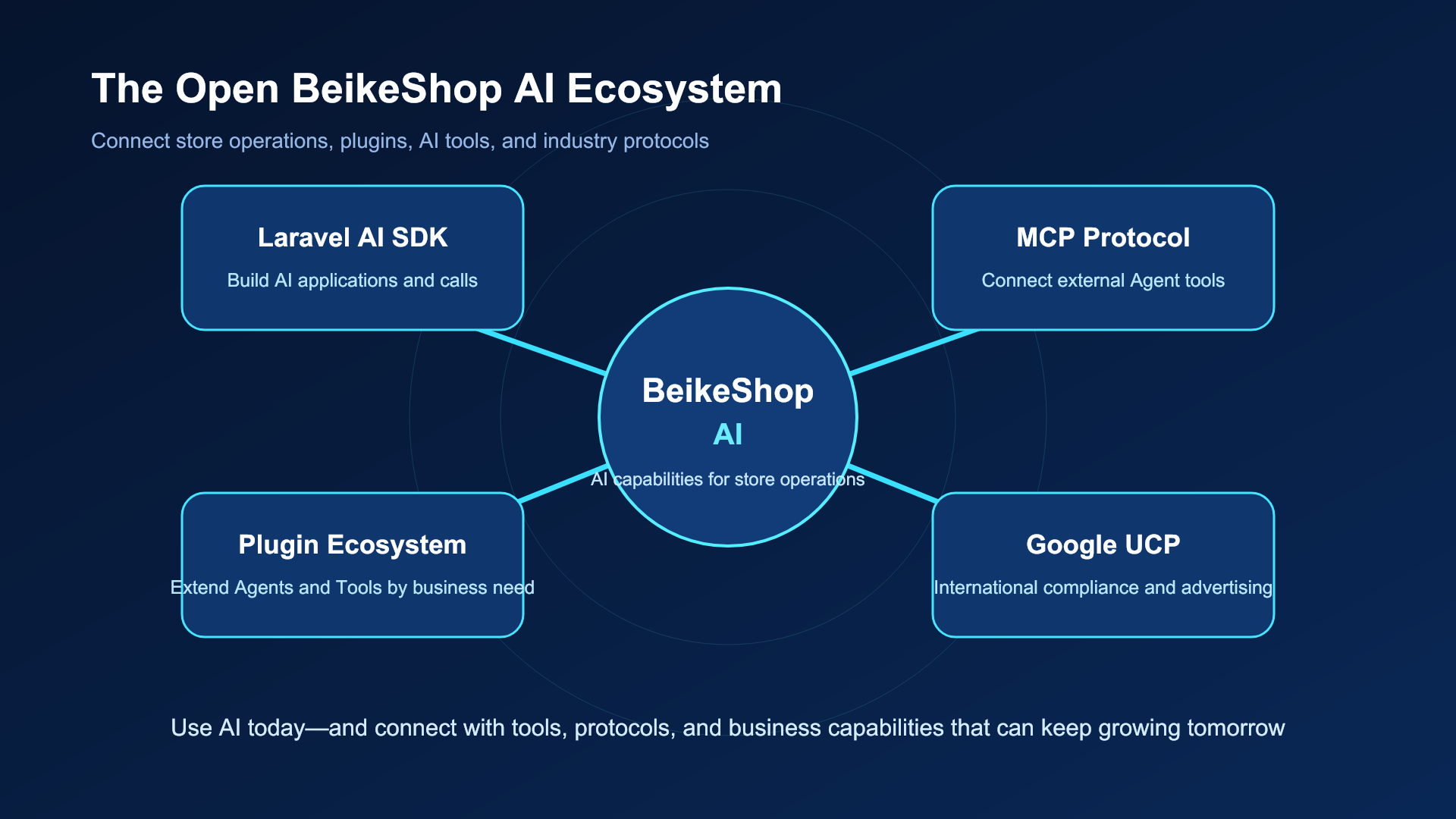
Beyond Plugins: Open Capabilities for the AI Ecosystem
v3.0 also integrates the Laravel AI SDK and supports the MCP protocol, enabling Agent tools such as OpenClaw and Hermes to manage the store. It also supports Google UCP integration to improve international compliance and advertising-related capabilities.
Together, these capabilities point to one goal: BeikeShop is designed not only to use AI, but also to connect with external AI tools and future industry protocols in a more open way.
For developers, this is a shift from adding an AI feature inside a store to building AI workflows around the store. For merchants, it means the freedom to adopt AI services that fit their business more closely instead of being limited to a fixed set of features.
Start with One Working Scenario
The most effective way to build AI capabilities is not to cover every workflow from the beginning. Start with one clear scenario: define an assistant, connect one tool, configure the relevant permissions, complete one real workflow in the admin panel, and then expand step by step.
Content maintenance, performance analysis, and after-sales coordination can all become starting points for plugin-based AI. When each capability has a clear responsibility, scenario, and permission boundary, AI can become a reliable business collaborator.
Let Store AI Grow with the Business
BeikeShop v3.0 License Edition's AI integration and extensibility do more than add several technical options. They provide merchants, developers, and service providers with a framework that can evolve over time.
AI assistants understand needs, business tools perform work, Hooks place capabilities in the right admin scenarios, and permissions keep every step under control. As more plugins and business scenarios are added, store AI will become more than a single feature—it will become a digital capability that grows with the business.
Learn more: AI Plugin Development Documentation | BeikeShop v3.0 Download Information
Welcome to contact us! Email: marketing@guangda.work
Click the link to learn about the product: https://beikeshop.com/
All rights reserved. Reprint must indicate the source!